
 China
China
 Hong Kong
 Japan
Japan
 Korea
Korea
 Cambodia
 Laos
Laos
 Malaysia
 Myanmar
 Philippines
 Singapore
 Thailand
 Vietnam
 Bhutan
 Maldives
 Sri Lanka


Phone:
+974 3300 0522
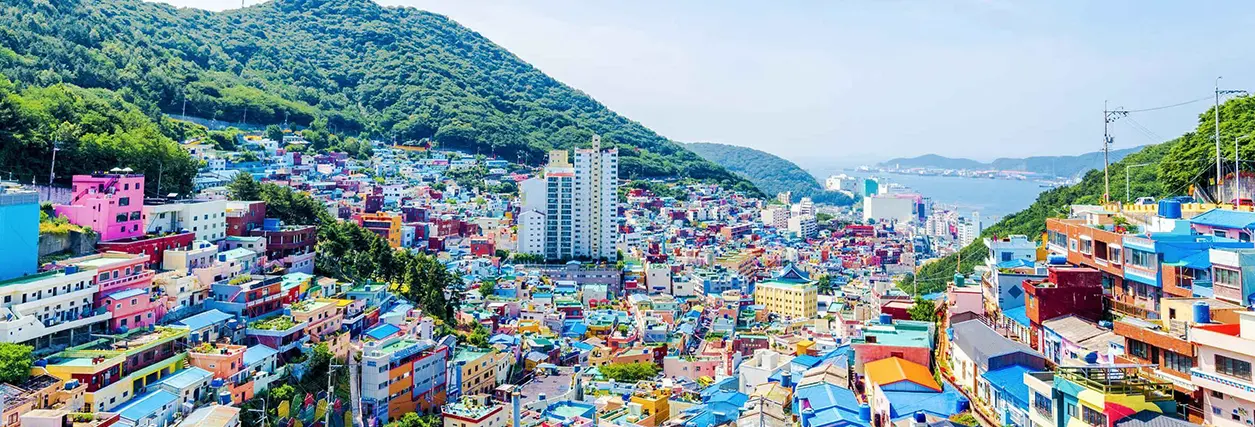
Gamcheon Culture Villiage is formed by houses built in staircase-fashion on the foothills of a coastal mountain, earning this village the nickname “Machu Picchu of Busan.” Many alleys that cut through this community are vibrantly decorated with murals and sculptures created by the residents.
GUKJE MARKET
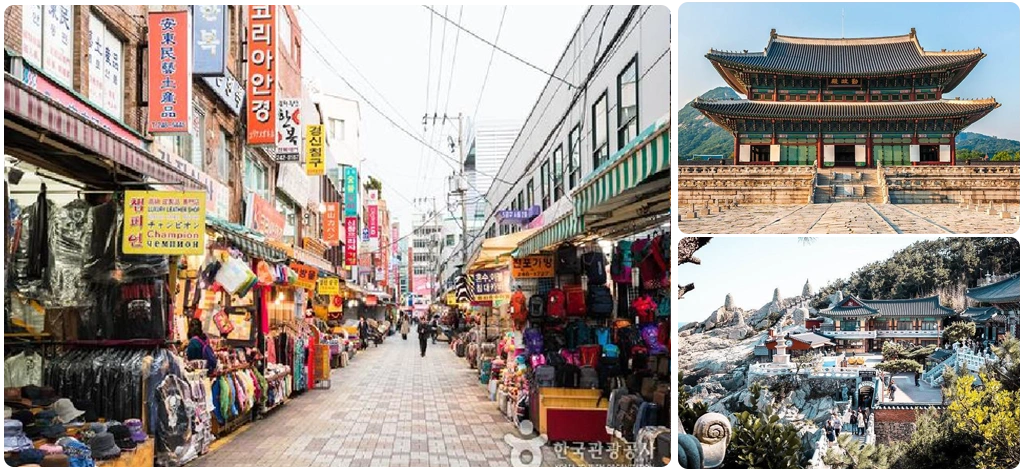
Following the Korean War, refugees who fled to Busan set up stalls in order to make a living by selling smuggled or imported products, which developed into Gukje Market (gukje meaning “international” in Korean) of today. Gukje Market is one of Korea’s largest markets.
JAGALCHI FISH MARKET
Jagalchi Market, located on the seaside road in Busan’s Jung-gu, is Korea’s largest seafood market, selling both live and dried fish. After the Korean War, the market solidified itself as a fish market. Most of the people who sell fish are women, so the vendors here are called Jagalchi Ajumma, “ajumma” meaning middle-aged or married woman in Korean.
HAEDONG YONGGUNGSA TEMPLE
Haedong Yonggungsa Temple is situated on the coast of the north-eastern portion of Busan. This superb attraction offers visitors the rare find of a temple along the shore line; most temples in Korea are located in the mountains. Haedong Yonggungsa Temple was first built in 1376 by the great Buddhist teacher known as Naong during the Goryeo dynasty.
IGIDAE PARK
Igidae refers to the beautiful bedrocks consisting of delicate rocks in the eastern sea that the Jangsanbong Peak of Yongho-dong, Nam-gu, faces. The name “Igidae” stands for the two gisaeng (female professional entertainers in Korean) from the Suyeong district who sacrificed their lives.
DONGBAEK ISLAND
Located near the south end of Haeundae Beach, Dongbaekseom Island was designated as a park in September 1, 1966. The island is full of dongbaek and pine trees and is connected to the main land by a bridge. The island also has a popular walking trail as well as badminton court, benches and restrooms.
NURIMARU APEC HOUSE
The name Nurimaru APEC House is created by combining the Korean words nuri (“world”) and maru (“summit”), and “APEC House,” which refers to an APEC conference hall. Collectively, it means “a house where the world summits gather together for an APEC meeting.”
NAMSAN TOWER
The N Seoul Tower, officially the YTN Seoul Tower and commonly known as Namsan Tower or Seoul Tower, is a communication and observation tower located on Namsan Mountain in central Seoul, South Korea. The 236- meter-tall tower marks the second highest point in Seoul.
NAMSANGOL HANOK VILLAGE
Namsangol Hanok Village opened in 1998 on the northern side of Namsan Mountain in the center of the capital. This village has five restored hanok (traditional Korean house) premises, a pavilion, traditional garden, performance art stage and a time capsule plaza, making it a perfect spot for both locals and tourists to take a leisure walk.
BLUE HOUSE
Cheongwadae, also known as the Blue House, is the executive office and official residence of the Republic of Korea’s head of state, the President of the Republic of Korea, located in Jongno-gu of the capital Seoul.
GYEONGBOK PALACE
Built in 1395, Gyeongbokgung Palace is commonly referred to as the Northern Palace because its location is furthest north when compared to the neighboring palaces of Changdeokgung (Eastern Palace) and Gyeonghuigung (Western Palace).
NATIONAL FOLKLORE MUSEUM
Located inside Gyeongbokgung Palace, the National Folk Museum of Korea presents historical artifacts that were used in the daily lives of Korean people in the past. Through the displays, visitors can learn about the domestic and agricultural lifestyles, as well as Korea’s cultural beliefs.
CHEONGGYECHEON STREAM
Cheonggyecheon is a 10.9-kilometre-long modern public recreation space in downtown Seoul, South Korea. The massive urban renewal project is on the site of a stream that flowed before the rapid post-war economic development caused it to be covered by transportation infrastructure
JOGYESA TEMPLE
Jogyesa is the chief temple of the Jogye Order of Korean Buddhism. The building dates back to the late 14th century and became the order’s chief temple in 1936. It thus plays a leading role in the current state of Seon Buddhism in South Korea
YEOUIDO PARK
Situated in Yeouido, the heart of politics, media, banking and finance, Yeouido Hangang Park is easily accessible via public transportation. The park hosts many exciting events, from the Yeouido Cherry Blossom Festival in spring to the International Fireworks Festival in fall, as well as concerts and marathons throughout the year.
What You Can Experience
Turn your tour into the journey of a lifetime with these packages.
A quick overview to make the most of your stay.